
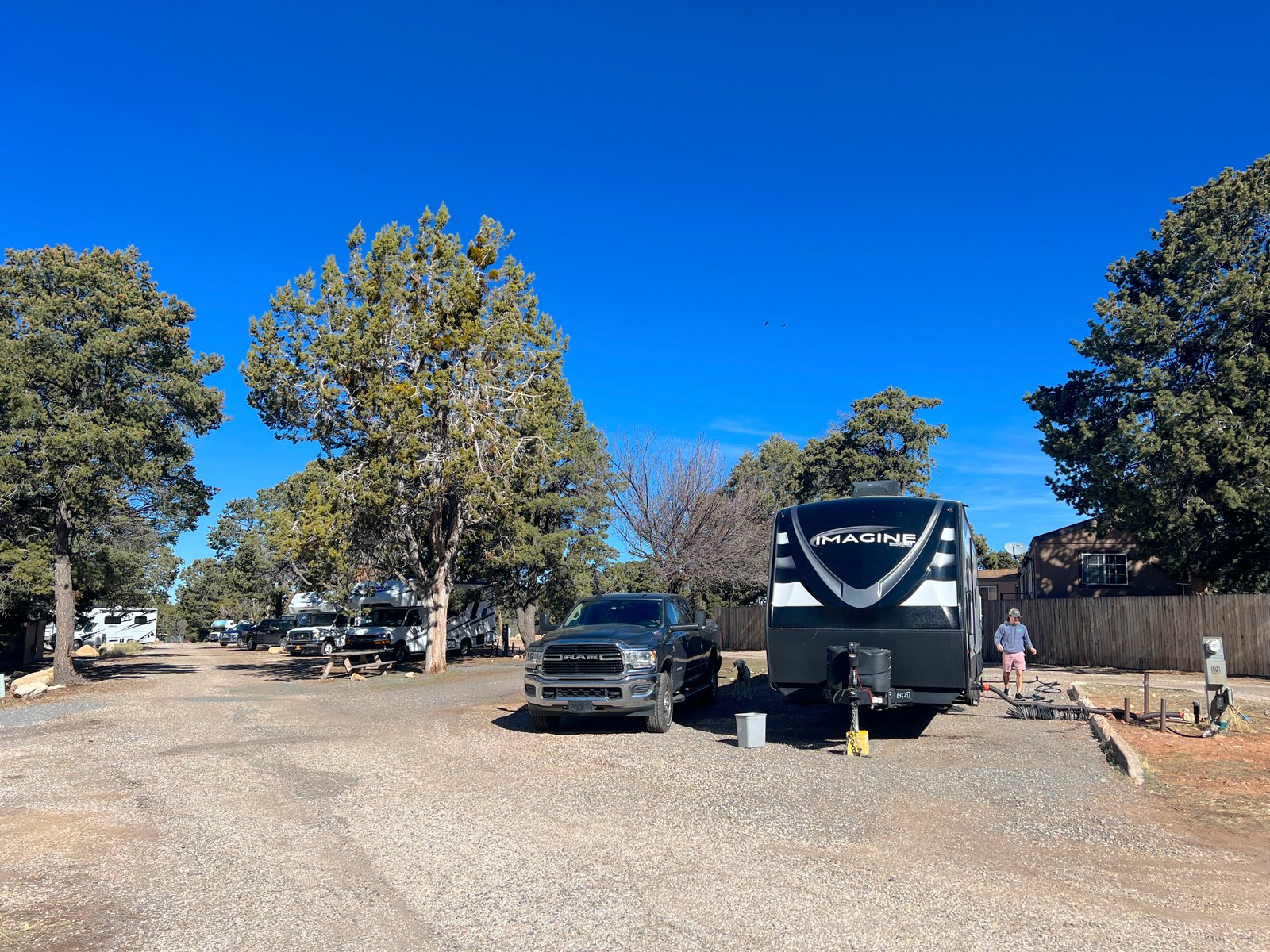
RV camping at the Grand Canyon is one of those rare trips that feels both iconic and surprisingly accessible. Whether you’re rolling in with a 40‑foot Class A or a compact camper van, the park has options for every setup—full‑hookup sites at the South Rim, quiet forest campgrounds near the North Rim, and scenic boondocking spots just outside the gates. But choosing the right campground, understanding the reservation system, and knowing what to expect at each rim can make or break your experience.
This guide walks you through everything you need to plan a smooth, stress‑free RV trip to the Grand Canyon—where to stay, what amenities you’ll actually find, how early to book, and the best nearby alternatives when the park campgrounds fill up. By the end, you’ll know exactly which RV sites fit your rig, your travel style, and the kind of Grand Canyon experience you want to have.
A Quick Look at What This Guide Includes
- Understanding the Rims — A clear breakdown of the South Rim vs. North Rim, including accessibility, scenery, crowds, and seasonal differences.
- Types of RV Camping — Full hookups, dry camping, boondocking, and nearby town options so you can choose the style that fits your rig and travel preferences.
- South Rim RV Campgrounds — Detailed descriptions of Trailer Village, Mather Campground, Desert View, Tusayan options, Williams, Valle, and Flagstaff RV parks.
- North Rim RV Campgrounds — In‑park camping, forest boondocking, plus DeMotte Campground, Jacob Lake Campground, and Kaibab Camper Village.
- Reservations & Booking Tips — How far in advance to book, seasonal availability, first‑come‑first‑served options, and backup plans.
- RV Length Limits & Road Conditions — What size rigs fit where, which roads are easiest, seasonal closures, and what to expect on forest roads.
- Weather & Seasonal Tips — Temperature swings, monsoon season, winter access, and how conditions differ between rims.
- Wildlife & Safety Tips — Staying safe around elk, deer, bison, and ravens, plus rim‑edge safety and nighttime campground awareness.
- Best Viewpoints Near Each Campground — The closest and most scenic overlooks you can reach from every major campground.
- Why Planning Matters — A quick reminder of why preparation makes RV travel at the Grand Canyon smoother and more enjoyable.
- Dump Stations, Water Fills & Fuel — Where to find essential services on both rims and nearby towns.
- FAQ — Answers to the most common RV camping questions.
- Helpful Links — Official maps, campground reservations, forest service pages, and road condition resources.
Quick Overview: RV Camping at the Grand Canyon
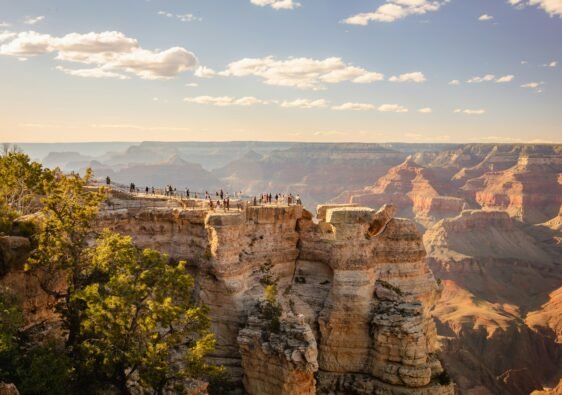
RV camping at the Grand Canyon feels a little different from other national parks — the distances are bigger, the rims each have their own personality, and the campground options can surprise you if you’re expecting a typical RV setup. The South Rim is where most travelers end up, with year‑round access, shuttle routes, and the only full‑hookup RV sites inside the park. The North Rim is a completely different experience: quiet, forested, seasonal, and better suited for smaller rigs and travelers who want that tucked‑away, high‑country feel.
You’ll find everything from full hookups to dry camping to wide‑open boondocking on the surrounding national forest land. RV length limits vary, and a few roads inside the park — like Hermit Road — don’t allow RVs at all, so planning ahead makes the whole trip smoother.
If this is your first time visiting the Grand Canyon, it helps to get oriented with a quick basics overview so you know how the rims connect, where the campgrounds sit, and how far everything actually is from each other.
Understanding the Rims: South Rim vs. North Rim
Before you choose an RV campground, it helps to understand how different the two rims really are. Most travelers picture the Grand Canyon as one central area, but the South Rim and North Rim feel like two completely separate parks — different elevations, different weather, different crowds, and very different camping experiences.
The South Rim is the classic Grand Canyon experience: year‑round access, shuttle routes, paved viewpoints, and the only full‑hookup RV sites inside the park. It’s busy, but it’s also the easiest place to base yourself if you want quick access to overlooks, visitor centers, and services.
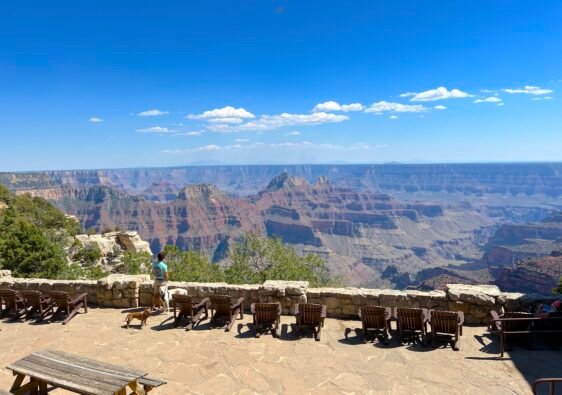
The North Rim sits over 1,000 feet higher and feels tucked away in the forest. It’s only open mid‑May through mid‑October, and everything about it is quieter — fewer people, fewer services, cooler temperatures, and a campground that’s better suited for smaller rigs. If you prefer a slower pace and don’t mind the seasonal access, the North Rim is a completely different kind of Grand Canyon trip.
Both rims are incredible, but they offer very different RV experiences. Knowing which one fits your travel style will make the rest of your planning much easier.
If you’re still deciding which rim fits your travel style, our One Day at the Grand Canyon South Rim and One Day at the Grand Canyon North Rim itineraries walk you through exactly what you can see in a single day. And if you’re leaning toward the South Rim, our Best Things to Do at the Grand Canyon South Rim guide highlights the top viewpoints, walks, and experiences.
Types of RV Camping at the Grand Canyon
RV camping at the Grand Canyon isn’t one‑size‑fits‑all. The park and the surrounding forest land offer a mix of full‑hookup sites, dry‑camping loops, and wide‑open boondocking areas, and each one gives you a slightly different experience of the canyon. Knowing the differences upfront helps you choose the style that fits your rig, your comfort level, and how close you want to be to the viewpoints.
Full‑hookup RV sites are only available at the South Rim, and they’re the easiest option if you want to roll in, plug in, and not think about water or power for the rest of your stay. These sites book quickly, especially in spring and fall, but they’re the most convenient way to camp inside the park.
Dry‑camping campgrounds are available at both rims and offer a more natural, quiet experience. You’ll be surrounded by pines instead of pavement, but you’ll need to arrive with full tanks and be comfortable managing your own power and water. These campgrounds are great for travelers who prefer a more traditional national‑park feel.
Private RV parks outside the park give you full hookups, showers, laundry, and easier availability. Towns like Tusayan, Williams, Valle, and Flagstaff all have RV parks that work well if the in‑park campgrounds are full or you want more amenities during your stay.
Boondocking on national forest land is the most flexible option. The Kaibab National Forest surrounds both rims, and there are plenty of dispersed camping areas where you can park for free if you’re fully self‑contained. It’s quiet, spacious, and perfect for travelers who like a little more freedom and don’t mind being farther from the canyon.
Each style has its own rhythm, and none of them are “wrong.” It just depends on the kind of Grand Canyon trip you want — convenient and close, quiet and rustic, or wide‑open and off‑grid.
South Rim RV Camping (Most Options + Year‑Round Access)
The South Rim is the most RV‑friendly part of the Grand Canyon, and it’s where most travelers end up camping. It stays open year‑round, has the most services, and gives you easy access to shuttle routes, paved viewpoints, and the main visitor center. It also offers the most flexibility overall — full hookups if you want convenience, dry‑camping loops if you prefer trees and quiet, and private RV parks just outside the gate if you need extra space or amenities. No matter which option you choose, you’ll be close to the canyon and all the major viewpoints.
Trailer Village RV Park ( Full Hookups Inside The Park )
Trailer Village is the only full‑hookup RV option inside Grand Canyon National Park, and it’s the spot most RV travelers choose when they want convenience above all else. Sites come with electric, water, and sewer hookups, and the paved pads make setup easy for everything from small trailers to big Class A rigs. It’s operated by a concessionaire, but the location feels very “national park” — quiet mornings, elk wandering through the campground, and a short walk to Market Plaza for groceries, coffee, and the post office.
You’ll be right on the Blue Route and Village Route shuttle lines, which makes getting around the South Rim incredibly simple without ever moving your rig. The trade‑off is that Trailer Village is more open and less private than the forested campgrounds nearby, but the hookups and central location more than make up for it if you prefer comfort and easy logistics.
- RV length limit: generally up to 50 feet
- Amenities: full hookups, dump station, laundry, showers nearby
- Location: walking distance to Market Plaza
- Shuttle access: Blue Route + Village Route
- Best for: families, long stays, winter visits
- Pros: full hookups, central location, paved sites, walking path to rim
- Cons: books early, less privacy than forested campgrounds, some loops are very unlevel
Reservations are essential, especially from April through October, and winter visitors should book ahead as well — Trailer Village stays open year‑round.
Mather Campground (Dry Camping Inside the Park)
Mather Campground is the main dry‑camping option at the South Rim, and it’s the spot most RV travelers choose when they want a quieter, more classic national‑park experience. The sites are tucked into a tall pine forest, giving you far more privacy and shade than the paved pads at Trailer Village. It’s dry camping only, but the trade‑off is a peaceful setting, spacious sites, and that “you’re really in the park” feeling that so many travelers love.
Even without hookups, Mather is incredibly convenient. You’ll be close to Market Plaza, the camp store, laundry, and showers, and the campground sits right on the shuttle system, making it easy to get to viewpoints without moving your rig. The pads are paved, the loops are easy to navigate, and the campground works well for everything from small trailers to mid‑size motorhomes.
It’s a great fit for travelers who don’t mind managing their own water and power and prefer trees, quiet, and a more natural setting over full hookups.
- RV length limit: generally up to 30 feet
- Amenities: water fill stations, dump station, restrooms, showers nearby, laundry
- Location: short walk or bike ride to Market Plaza
- Shuttle access: Blue Route
- Best for: tent campers, smaller RVs, travelers who prefer forested sites
- Pros: wooded and private, spacious sites, central location, walking path to rim
- Cons: no hookups, books early in peak season
Reservations are strongly recommended from spring through fall, especially if you’re traveling with a specific rig length or want a more private loop.
Desert View Campground (Quiet, Scenic, and More Remote)
Desert View Campground sits on the far eastern side of the South Rim and offers a completely different experience from the busy Village area. It’s quieter, more open, and just a short walk from the Desert View Watchtower — one of the best sunrise and sunset spots in the entire park. If you like the idea of being close to the canyon but away from the crowds, this is the South Rim campground that delivers that peaceful, tucked‑away feel.
This is a dry‑camping campground, and the sites are simple but scenic. You’ll be surrounded by pinyon and juniper instead of tall pines, and the views open up quickly as you walk toward the rim. It’s a great fit for smaller RVs and travelers who don’t mind being farther from Market Plaza and the main shuttle routes. The trade‑off is worth it if you want quiet nights, dark skies, and easy access to the Watchtower area.
Desert View is more rustic than Mather, but that’s part of its charm — fewer people, fewer lights, and a slower pace overall.
- RV length limit: generally up to 30 feet
- Amenities: restrooms, potable water, picnic tables, fire rings; small store and services nearby
- Location: Desert View area, about 23 miles east of Grand Canyon Village
- Shuttle access: none — you’ll rely on your own vehicle
- Best for: smaller rigs, sunrise/sunset chasers, travelers who prefer quiet and simplicity
- Pros: peaceful setting, close to the Watchtower, great views
- Cons: no hookups, no shuttle access, farther from main services
Desert View typically fills on weekends during peak season, and because it’s more remote, it’s best for travelers who are comfortable dry camping and don’t mind being outside the main Village hub.
Tusayan RV Parks (Full Hookups Just Outside the South Rim Entrance)
If the in‑park campgrounds are full or you want a few more amenities during your stay, Tusayan is the closest and most convenient place to base yourself. This small gateway town sits just five minutes from the South Rim entrance, and it offers one true full‑hookup RV park plus a couple of quiet national‑forest campgrounds nearby. It’s not as quiet or scenic as camping inside the park, but the trade‑off is comfort, availability, and easy access to restaurants, groceries, gas, and the seasonal shuttle into the South Rim.
Tusayan works especially well for travelers with larger rigs, families who want extra space, or anyone visiting during peak season when Trailer Village and Mather Campground book out months ahead. You’ll still be close enough to drive into the park for sunrise, hop on the shuttles, and explore the viewpoints without feeling like you’re “staying far away.”
Grand Canyon Camper Village (Full Hookups)
This is the main RV park in Tusayan and the closest full‑hookup option outside the park. Sites are simple and functional — think more “basecamp” than “scenic campground” — but you get electric, water, and sewer hookups, plus walkable access to restaurants and shops in town. It’s a great fit for big rigs, families, and anyone visiting during peak season when Trailer Village is booked out.
- RV length limit: accommodates most big rigs
- Amenities: full hookups, shade trees, level pads, walkable to town
- Location: 5 minutes from the South Entrance Station
- Pros: closest full‑hookup option outside the park, reliable availability
- Cons: more of a parking‑lot feel, not a forested setting
Tusayan‑Area National Forest Campgrounds (Dry Camping)
These campgrounds sit just south of Tusayan in the Kaibab National Forest. They’re dry‑camping options, but they offer a quieter, more natural setting than Camper Village while still keeping you close to the South Rim.
Ten‑X Campground (Dry Camping)
A peaceful, wooded national‑forest campground just a few minutes from Tusayan. Sites are shaded, quiet, and well‑spaced — a great alternative if you prefer trees and privacy over hookups.
- RV length limit: varies; best for small–mid rigs
- Amenities: restrooms, picnic tables, shaded loops
- Location: just south of Tusayan
- Pros: quiet, forested, affordable
- Cons: no hookups
Tusayan‑Montane Campground (Dry Camping)
A newer, small national‑forest campground near Ten‑X. It’s rustic, quiet, and ideal for travelers who want a simple, uncrowded place to stay close to the South Rim.
- RV length limit: varies
- Amenities: basic forest‑service campground
- Location: near Ten‑X, south of Tusayan
- Pros: peaceful, scenic, uncrowded
- Cons: no hookups, limited services
Why Stay in Tusayan?
Tusayan is a great option if:
- you’re traveling with a big rig
- you want full hookups but Trailer Village is booked
- you’re visiting during peak season
- you prefer town conveniences (restaurants, groceries, gas)
- you want a reliable backup plan close to the park
Tusayan is a great backup — or even a great primary option — if you want comfort and convenience without sacrificing proximity to the canyon.
South Rim Boondocking (Kaibab National Forest Dispersed Camping)
If you’re fully self‑contained and prefer wide‑open space over hookups, the Kaibab National Forest offers excellent boondocking options just outside the South Rim. These dispersed sites sit among pines and meadows, with plenty of room for smaller rigs and vans, and occasional spots that can accommodate larger RVs. It’s quiet, scenic, and far less crowded than the campgrounds inside the park — a great choice if you want solitude without being too far from the canyon.
Boondocking here is free, and you can stay up to 14 days in most areas. The roads vary from smooth gravel to rough forest tracks, so it’s best to scout ahead or arrive during daylight. You’ll be camping without services, so you’ll need to bring your own water, manage your tanks, and pack out everything you bring in.
The biggest advantage is flexibility: no reservations, no campground loops, and no crowds. You can wake up to birdsong, enjoy dark skies at night, and still be just a short drive from the South Entrance Station.
Best areas for boondocking near the South Rim:
- Forest roads south of Tusayan
- Areas near Ten‑X Campground
- Pullouts along FR 302 and FR 688 (road conditions vary)
Best for: self‑contained rigs, travelers seeking quiet, budget‑friendly camping
Pros: free, peaceful, spacious, great stargazing
Cons: no services, rough roads, weather‑dependent access
Boondocking near the South Rim is ideal if you want a more natural, off‑grid experience while staying close enough to enjoy sunrise, sunset, and the main viewpoints without a long drive.
Valle RV Parks (Budget‑Friendly, 30 Minutes from the South Rim)
Valle — also known as Grand Canyon Junction — is a small crossroads town about 30 minutes from the South Rim. It’s not scenic, but it’s a practical option if you want full hookups at a lower price or you’re arriving late and need an easy place to park for the night. Valle works well for travelers coming from Williams or Flagstaff, and it’s a reliable backup when Tusayan and in‑park campgrounds are booked.
Grand Canyon RV Park at Raptor Ranch
Grand Canyon RV Park at Raptor Ranch is a simple, easy‑access RV park located about 30 minutes from the South Rim. Sites are level, straightforward, and offer full hookups — making it a practical overnight stop or budget‑friendly basecamp close to the canyon. The property also features the Raptor Ranch attraction, giving travelers a unique stopover experience you won’t find elsewhere in Valle.
Amenities: full hookups, level pads, on‑site attractions at Raptor Ranch
Best for: big rigs, budget travelers, late arrivals, families wanting a fun stopover
Why Stay in Valle?
Valle is a good choice if you want:
- full hookups at lower prices
- easier availability during peak season
- a simple overnight stop close to the South Rim
- a basecamp between Williams and the canyon
It’s not the most scenic option, but it’s practical — and for many RV travelers, that’s exactly what you need.
Williams RV Parks (Full Hookups, 1 Hour from the South Rim)
Williams is a popular basecamp for Grand Canyon travelers who want full hookups, easier availability, and a classic Route 66 town to explore between canyon days. It’s about one hour from the South Rim, making it farther than Tusayan but still close enough for day trips. The RV parks here offer more amenities, more space, and more options for big rigs than anything inside the park.
Williams works especially well for travelers coming from Phoenix or Las Vegas, families who want a town with restaurants and activities, or anyone visiting during peak season when Trailer Village and Tusayan are booked out.
Railside RV Ranch
A friendly, full‑hookup RV park with level sites, shade trees, and easy access to downtown Williams. Known for its quiet atmosphere and reliable availability.
- Amenities: full hookups, laundry, showers, Wi‑Fi
- Best for: big rigs, long stays, travelers wanting comfort and convenience
Grand Canyon Railway RV Park
Located next to the historic railway depot, this is one of the most popular RV parks in Williams. It offers full hookups, paved pads, and access to the hotel’s pool and amenities.
- Amenities: full hookups, paved sites, pool access, laundry, showers
- Best for: families, travelers riding the Grand Canyon Railway
Canyon Motel & RV Park
A unique RV park with wooded surroundings and a quieter feel than the in‑town options. Offers full hookups and a more rustic vibe while still being close to Route 66.
- Amenities: full hookups, wooded sites, laundry, showers
- Best for: travelers wanting a quieter setting near town
Grand Canyon / Williams KOA Holiday
A popular, full‑service KOA with spacious sites, tall pines, and plenty of amenities for families and long‑term travelers. This campground offers full hookups, a pool, laundry, and KOA‑style conveniences that make it a comfortable basecamp for exploring both Williams and the South Rim. It’s about an hour from the canyon, but the amenities and peaceful forest setting make the extra drive worth it for many RV travelers.
Amenities: full hookups, pool, laundry, showers, camp store, tall pines
Best for: families, long stays, travelers wanting KOA amenities and a quieter forest setting
Why Stay in Williams?
Williams is a great option if you want:
- full hookups and spacious sites
- easier reservations during peak season
- a fun Route 66 town with restaurants and activities
- a comfortable basecamp for longer trips
It’s farther from the canyon, but the amenities and availability make it a reliable alternative when in‑park options are full.
Flagstaff RV Parks (Full‑Service City Basecamp, 1.5 Hours from the South Rim)
Flagstaff isn’t the closest option to the Grand Canyon, but it’s a great choice if you want a full‑service city with grocery stores, breweries, outdoor shops, and multiple RV parks that can easily accommodate big rigs. It’s about 1.5 hours from the South Rim, making it farther than most travelers prefer for daily canyon visits, but the trade‑off is comfort, cooler temperatures, and plenty of amenities. Flagstaff works well for longer trips, travelers who want a city basecamp, or anyone combining the Grand Canyon with Sedona, Walnut Canyon, Sunset Crater, or other northern Arizona destinations.
North Rim RV Camping Options ( Seasonal & Scenic )
The North Rim is a completely different kind of Grand Canyon trip — quieter, cooler, more forested, and far less developed than the South Rim. It sits over 1,000 feet higher, which means crisp mornings, dark skies, and a slower pace overall. If you’re looking for solitude and that tucked‑away, high‑country feel, this is where you’ll find it.
RV options here are limited, and the entire area is seasonal, typically open from mid‑May through mid‑October. Snow closes the road each winter, and services wind down quickly once the season ends. But if your timing lines up, the North Rim offers one of the most peaceful RV camping experiences anywhere in the national park system.
North Rim Campground (Dry Camping Inside the Park)
The North Rim Campground is the only in‑park RV option on this side of the canyon, and it’s perfect for travelers who prefer quiet, forested sites over hookups and amenities. The campground sits in a beautiful ponderosa pine and aspen forest, with some sites offering partial canyon views and easy access to the Transept Trail.
This is dry camping only, and the sites are best suited for smaller rigs — generally up to 30 feet. The loops are tighter, the roads are narrower, and the entire campground feels more rustic than anything at the South Rim. But that’s exactly what makes it special: fewer crowds, cooler temperatures, and a peaceful setting that feels worlds away from the busy Village area.
- RV length limit: generally up to 30 feet
- Amenities: restrooms, potable water, dump station nearby
- Location: short drive from the North Rim Visitor Center and lodge
- Shuttle access: none
- Best for: smaller RVs, quiet campers, travelers who prefer forested sites
- Pros: peaceful, scenic, cooler temperatures, great access to trails
- Cons: no hookups, seasonal access, limited availability for larger rigs
Reservations are strongly recommended, especially for summer visits. Because the season is short, the campground fills quickly.
Kaibab National Forest (Boondocking Near the North Rim)
If you’re fully self‑contained and want even more space and solitude, the Kaibab National Forest offers excellent boondocking options just outside the North Rim entrance. These dispersed sites sit among pines and meadows, with plenty of room for smaller rigs and vans. Larger RVs can sometimes find space too, but the roads can be rough and narrow in places.
This is the most flexible way to camp near the North Rim — no reservations, no crowds, and wide‑open skies. It’s perfect for travelers who don’t mind being farther from services and want a quiet, off‑grid experience.
- RV length limit: varies; best for smaller rigs
- Amenities: none — fully self‑contained camping only
- Location: forest roads near the North Rim entrance
- Best for: boondockers, self‑contained rigs, travelers seeking solitude
- Pros: free, quiet, spacious, great stargazing
- Cons: no services, rough roads, weather‑dependent access
Nearby Campgrounds Outside the North Rim
DeMotte Campground (Kaibab National Forest)
Located about 17 miles north of the North Rim entrance, DeMotte Campground is a quiet, forested option surrounded by aspens and pines. It’s a great alternative when the North Rim Campground is full or if you prefer a more rustic national‑forest setting. Sites are spacious, shaded, and well‑suited for smaller to mid‑sized RVs.
- Amenities: dry camping, picnic tables, fire rings, vault toilets
- Best for: smaller rigs, travelers wanting a peaceful forest setting close to the North Rim
Jacob Lake Campground (Kaibab National Forest)
Situated 30 miles from the North Rim, Jacob Lake Campground offers a cooler, high‑country setting with tall pines and easy access to the Jacob Lake Inn for cookies, soft‑serve, and supplies. It’s farther from the canyon but makes a great basecamp if you’re exploring both the North Rim and the Kaibab Plateau.
- Amenities: dry camping, picnic tables, fire rings, vault toilets
- Best for: travelers wanting a quiet forest stay with easy access to food and lodging nearby
Kaibab Camper Village (Jacob Lake)
Kaibab Camper Village is the only full‑hookup RV park near the North Rim, located just south of Jacob Lake. It’s a practical choice if you want hookups, level sites, and a straightforward stay in the forest. The drive to the North Rim is longer, but the comfort and convenience make it a solid option for big rigs.
- Amenities: full hookups, level pads, camp store nearby at Jacob Lake Inn
- Best for: big rigs, travelers wanting full hookups near the North Rim
Reservations & Booking Tips for RV Camping at the Grand Canyon
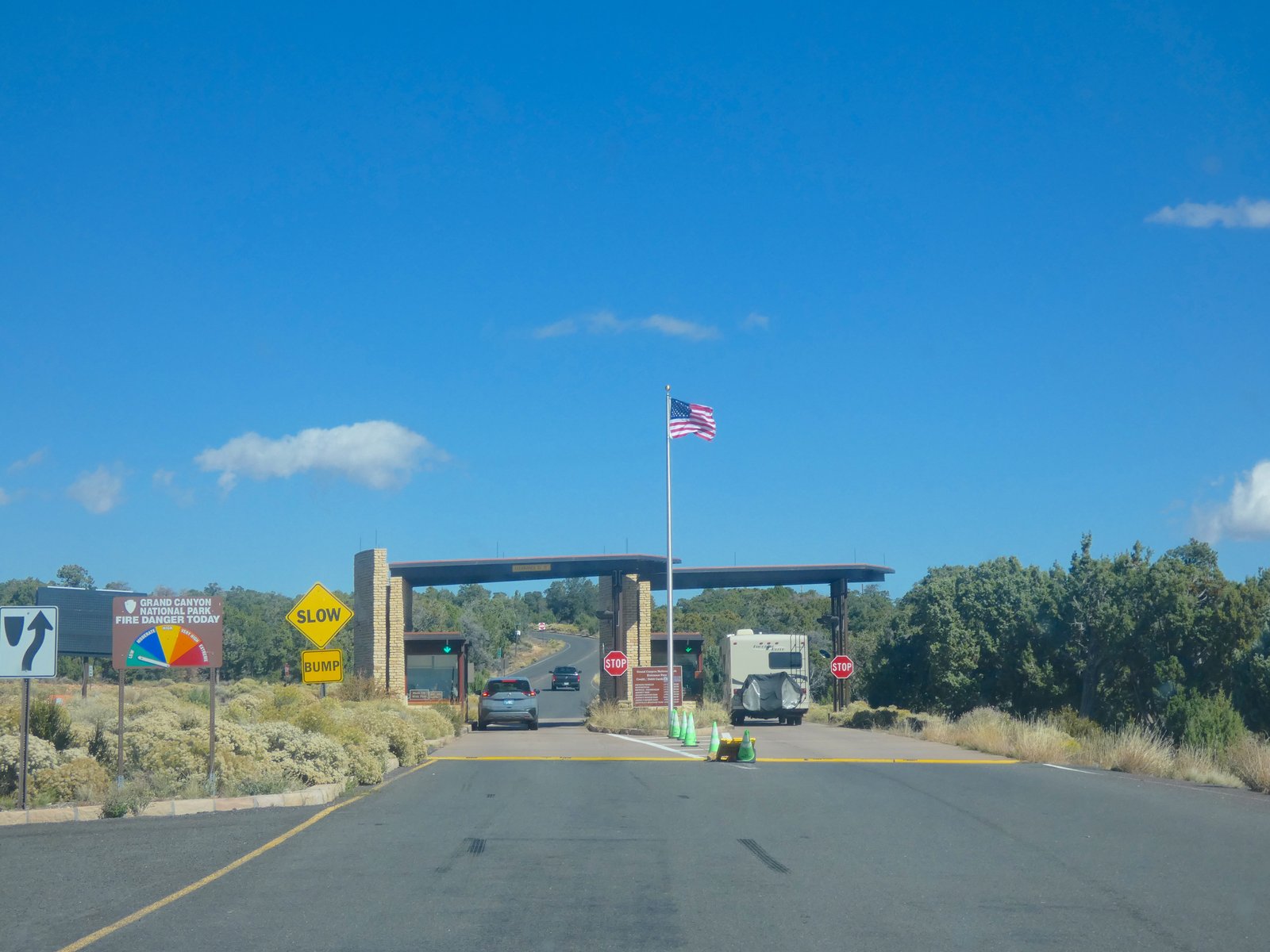
RV camping at the Grand Canyon is competitive, especially on the South Rim. Some campgrounds book out months in advance, while others operate on a first‑come, first‑served basis. Planning ahead makes the difference between a smooth trip and scrambling for last‑minute options. Here’s exactly what you need to know.
South Rim Reservations
Trailer Village RV Park (Full Hookups)
- Book as early as possible, especially for spring–fall.
- Summer and holiday weeks often fill 3–6 months ahead.
- Winter stays are easier to book, and Trailer Village remains open year‑round.
Mather Campground (Dry Camping)
- Reservations open 6 months in advance on Recreation.gov.
- Spring through fall fills quickly, especially weekends.
- If you want a shaded or more private loop, book early.
Desert View Campground (Dry Camping)
- Reservations required; opens 6 months out.
- Fills on weekends and peak season but is easier to book than Mather.
Tusayan RV Parks
- Grand Canyon Camper Village: reservations recommended but often available last‑minute.
- Ten‑X & Tusayan‑Montane: first‑come, first‑served; arrive early in the day during peak season.
Williams & Valle RV Parks
- Usually easier to book than Tusayan or in‑park campgrounds.
- Great backups when everything closer to the canyon is full.
North Rim Reservations
North Rim Campground (Dry Camping)
- Open mid‑May through mid‑October only.
- Reservations open 6 months in advance and fill quickly due to the short season.
- Smaller rigs have an easier time finding sites.
Kaibab National Forest (Boondocking)
- No reservations; free dispersed camping.
- Arrive early to scout roads and find a level spot.
DeMotte Campground (Kaibab National Forest)
- First‑come, first‑served.
- Fills on weekends but usually easier to get than the in‑park campground.
- Best to arrive before early afternoon during peak season.
Jacob Lake Campground (Kaibab National Forest)
- First‑come, first‑served.
- Farther from the rim, so availability is usually good.
- Great backup if DeMotte is full.
Kaibab Camper Village (Jacob Lake)
- Reservations recommended, especially for full‑hookup sites.
- Often available last‑minute due to its distance from the rim.
- Best option for big rigs needing hookups near the North Rim.
Best Time to Book
- Peak Season (May–September): book 3–6 months ahead.
- Shoulder Season (April, October): book 1–3 months ahead.
- Winter (South Rim only): Trailer Village is usually available; Mather has limited winter loops.
Tips for Getting a Site When Everything Is Full
- Check Tusayan first for full hookups.
- Look at Williams or Valle for last‑minute availability.
- Use Kaibab National Forest for flexible, no‑reservation camping.
- Try mid‑week dates — weekends fill fastest.
- Look for cancellations on Recreation.gov (they happen often).
When to Arrive for First‑Come, First‑Served Campgrounds
For Ten‑X, Tusayan‑Montane, and boondocking areas:
- Arrive before noon during peak season.
- Avoid arriving after dark — forest roads can be rough.
- Weekdays offer better availability than weekends.
Once your campsite is booked, our Grand Canyon Packing List covers everything you’ll want to bring on your visit plus day hikes and changing weather. If you’re planning to explore the trails, our Best Easy Hikes in the Grand Canyon guide breaks down beginner‑friendly options on both rims.
RV Length Limits & Road Conditions at the Grand Canyon
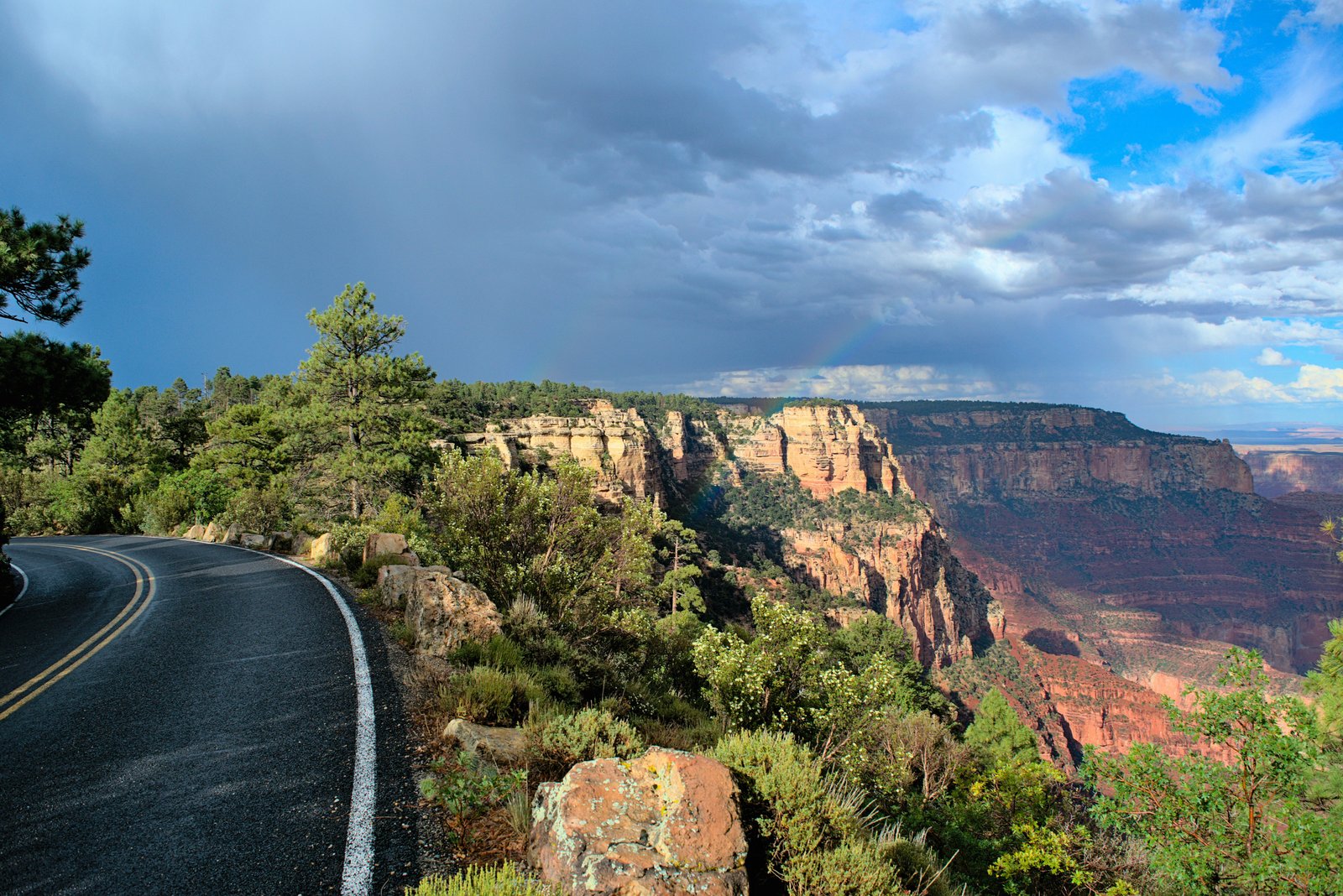
RV size matters at the Grand Canyon — not just for campground reservations, but for navigating tight loops, parking at viewpoints, and driving forest roads if you plan to boondock. The South Rim is generally friendly to larger rigs, while the North Rim and national‑forest roads favor smaller setups. Here’s what you need to know before you arrive.
RV Length Limits by Campground
Trailer Village RV Park (South Rim)
- Best option for big rigs
- Sites accommodate up to 50 feet
- Wide roads and easy back‑in/ pull‑through sites
Mather Campground (South Rim)
- Most sites fit up to 30 feet
- A few larger sites exist, but loops are tighter
- Best for small–mid RVs, vans, and trailers
Desert View Campground (South Rim)
- Generally fits rigs up to 30 feet
- Narrower roads and smaller pads
- Best for compact RVs and trailers
Grand Canyon Camper Village (Tusayan)
- Accommodates most big rigs
- Full hookups and wide access roads
Ten‑X & Tusayan‑Montane (National Forest)
- RV length varies by site
- Best for small–mid rigs
- Larger RVs may struggle with tight turns or uneven pads
Williams RV Parks
- Railside, Railway RV Park, and Canyon Motel all accommodate big rigs
- Full hookups and easy access roads
Valle RV Parks
- Grand Canyon Inn RV Park fits large rigs
- Simple, level sites with full hookups
North Rim Campground
- Best for rigs up to 30 feet
- Loops are narrow and forested
- Larger RVs may have difficulty maneuvering
Kaibab National Forest (North Rim Boondocking)
- Best for small–mid rigs
- Larger RVs can sometimes find space, but forest roads are rough
Road Conditions to Expect
South Rim Roads
Roads on the South Rim are paved, well‑maintained, and easy for large RVs. Parking lots at major viewpoints can get tight during peak season, especially midday. Desert View Drive is very RV‑friendly, but pullouts fill quickly on busy days. There are no major grades, making this area comfortable for towing.
Tusayan & Valle
Highway 64 between Tusayan, Valle, and the South Rim is smooth, wide, and straightforward for big rigs. Traffic increases significantly during peak season, especially around the South Entrance Station, but the drive itself is easy.
Williams to the South Rim
The drive from Williams to the South Rim along Highway 64 is simple and direct. Wildlife crossings are common, especially elk and deer at dawn and dusk, so it’s worth taking it slow. There are no steep grades on this route.
Flagstaff to the South Rim
Highway 180 combined with Highway 64 is a scenic route with rolling hills and forested views. Winter storms can bring snow and icy conditions from November through April, so travelers should check weather forecasts before driving this stretch.
North Rim Roads
Highway 67 to the North Rim is paved but seasonal, with narrow sections and forested shoulders. Wildlife—especially bison and deer—often wander onto the road. The highway closes in winter due to heavy snow, and access is only possible from mid‑May to mid‑October.
National Forest Roads (Boondocking Areas)
Forest roads near both rims vary widely, from smooth gravel to rough, rutted tracks. It’s best to scout ahead or arrive during daylight to avoid soft shoulders or deep ruts. After monsoon rains in July and August, roads can become muddy and challenging for low‑clearance RVs.
Parking Considerations for RVs At Grand Canyon National Park
- Most South Rim viewpoints have RV‑friendly parking, but it fills early.
- The main Visitor Center lot has designated RV spaces.
- Desert View Watchtower has limited RV parking during peak hours.
- North Rim parking is smaller and more forested — arrive early.
- Shuttle buses do not accommodate RVs; you’ll need to drive yourself.
Towing a Vehicle
Many RV travelers tow a small car (“toad”) for easier parking and access. It’s not required, but it makes exploring viewpoints, grocery runs, and scenic drives much simpler — especially at the North Rim.
Weather & Seasonal Tips for RV Camping at the Grand Canyon
The Grand Canyon’s weather changes fast — not just season to season, but hour to hour. RV travelers need to be prepared for extreme temperatures, sudden storms, and big elevation differences between the South Rim and North Rim. Here’s what to expect throughout the year.
Spring (March–May)
Spring is one of the most comfortable seasons at the South Rim, with cool mornings, mild afternoons, and fewer crowds. But it’s also known for high winds, especially in March and April. Dust can kick up quickly, and temperatures swing from chilly to warm in a single day.
- Expect gusty winds and blowing dust
- Nights can still drop below freezing
- Great time for hiking and photography
- North Rim remains closed until mid‑May
RV Tip: Secure awnings and outdoor gear — spring winds can be strong enough to damage equipment.
Summer (June–August)
Summer brings extreme heat at the South Rim and even hotter temperatures in nearby towns like Tusayan, Williams, and Valle. Afternoon monsoon storms are common from July through early September, bringing heavy rain, lightning, and sudden flooding.
- South Rim highs often reach the 80s–90s
- Tusayan and Valle can hit 100+ degrees
- Monsoon storms build quickly in the afternoons
- Parking lots and viewpoints get crowded
RV Tip: Use early mornings and late evenings for outdoor activities. Keep your rig shaded when possible and watch for soft, muddy forest roads after storms.
Fall (September–October)
Fall is one of the best seasons for RV camping. Temperatures are comfortable, skies are clear, and the canyon’s light is beautiful for photography. Winds calm down, crowds thin out, and both rims are fully open.
- Warm days, cool nights
- Stable weather and great visibility
- Ideal for hiking, scenic drives, and sunrise/sunset
RV Tip: Nights get chilly by late October — be prepared to disconnect water lines if temperatures drop below freezing.
Winter (November–February)
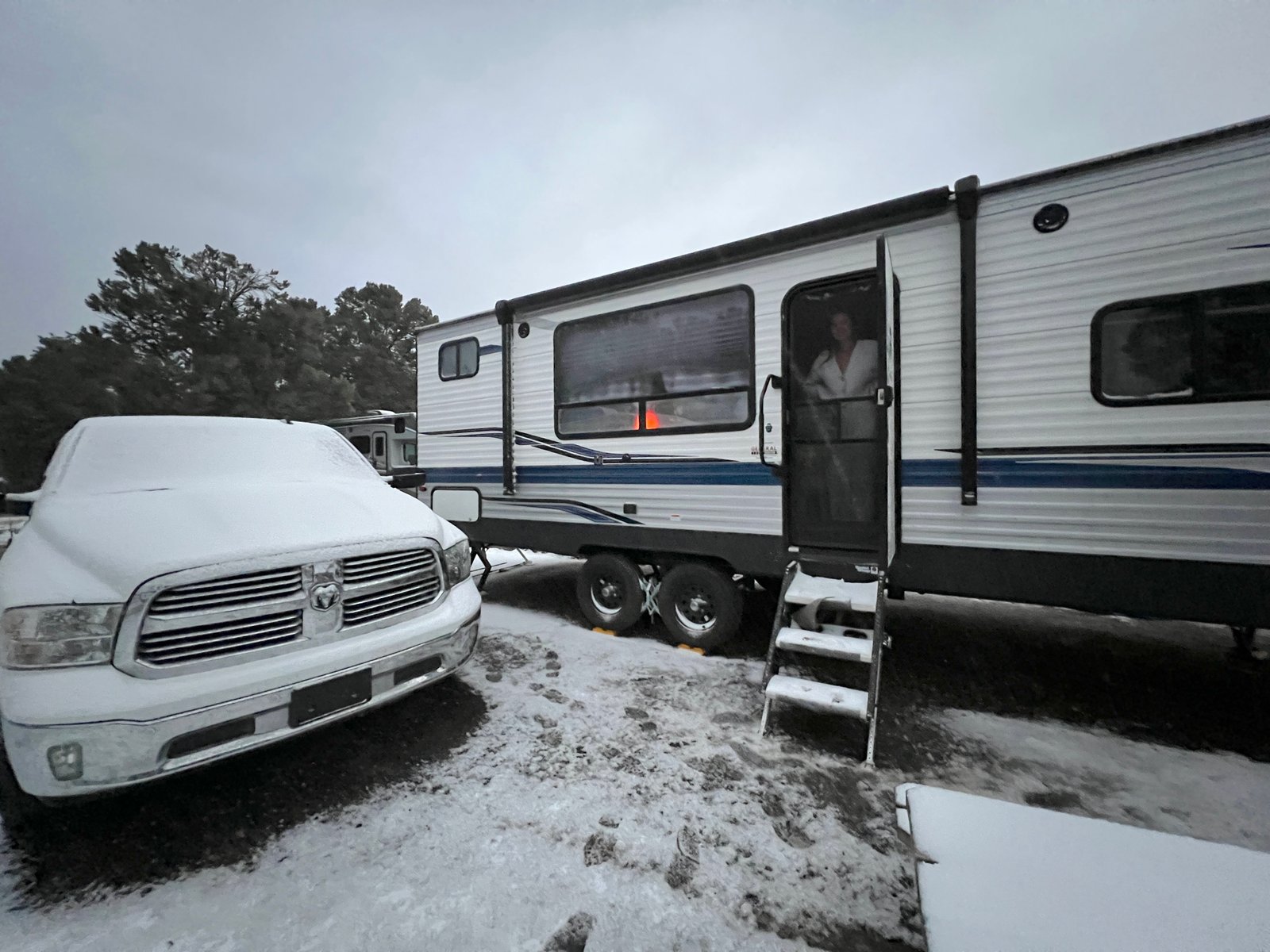
Winter at the South Rim is quiet, peaceful, and cold. Trailer Village stays open year‑round, but Mather Campground has limited winter loops. Snow and ice are common, and nighttime temperatures regularly fall below freezing.
- Highs in the 40s–50s, lows below freezing
- Snow possible anytime from November–March
- Roads can be icy in the mornings
- North Rim is fully closed for the season
RV Tip: Use heated hoses or disconnect water lines overnight. Keep propane topped off — you’ll use more than you expect.
North Rim Seasonal Notes
The North Rim sits over 1,000 feet higher than the South Rim, which means temperatures stay cooler throughout the year. The season is short — the rim is only open from mid‑May through mid‑October, and snow often lingers well into late spring. Even in summer, nights can be cold, so travelers should be prepared for big temperature swings. Fall storms can arrive quickly and occasionally close roads earlier than expected.
RV Tip: Bring extra layers and be ready for chilly mornings. Forest roads near the North Rim can become muddy or rutted after rain, especially during monsoon season.
General Weather Tips for RV Travelers
Temperatures at the Grand Canyon can swing 30–40 degrees between day and night, so it’s important to plan for both warm afternoons and cold mornings. Wind can happen anytime, especially at exposed viewpoints, and monsoon storms bring lightning that makes rim edges unsafe. Late‑summer wildfire smoke can affect visibility, and conditions can change quickly at high elevation. Checking the weather daily is the best way to stay ahead of sudden shifts.
Wildlife & Safety Tips
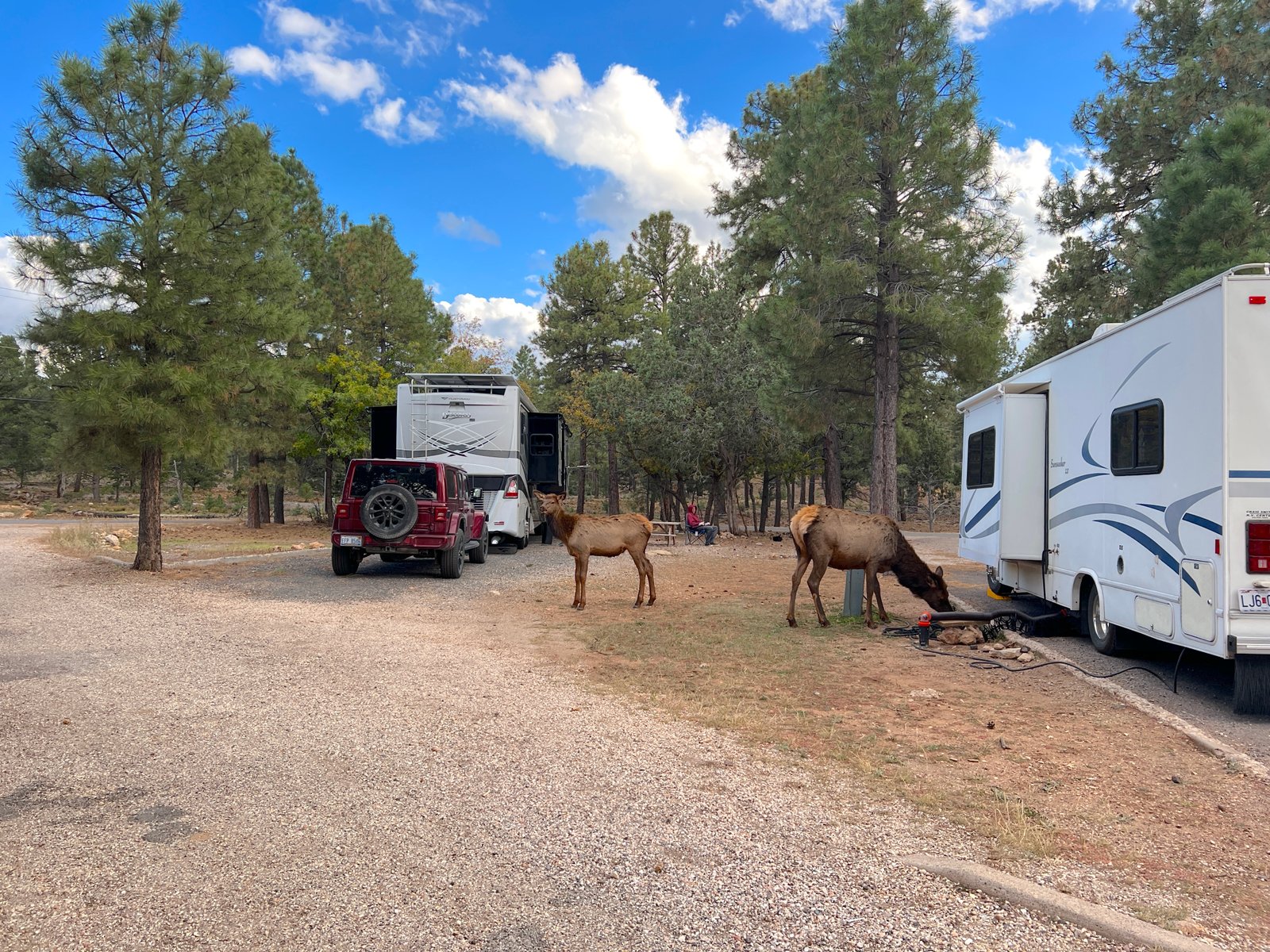
You’ll see plenty of wildlife around the Grand Canyon, especially on the South Rim. Most animals look calm, but they’re still wild — giving them space keeps everyone safe.
- Elk: Common in Trailer Village and Market Plaza. They’re huge and can charge if startled. Keep dogs leashed and never approach for photos.
- Mule Deer: Often seen near campgrounds and along roads at dawn and dusk. Drive slowly and let them pass.
- Ravens: Smart and bold. They’ll unzip backpacks and steal food. Keep all food and trash inside your RV.
- Coyotes: Usually keep their distance. Don’t leave pet food outside and supervise small pets.
- Bison (North Rim): Massive and unpredictable. Stay far back and give them the entire road if they’re blocking it.
General Safety
Store all food and trash securely, as wildlife is quick to investigate anything left outside. Keep pets leashed at all times — elk, coyotes, and even ravens can create dangerous situations for off‑leash animals. Expect wildlife to move through campgrounds at night, so stay aware when walking around after dark. Drive slowly in forested areas, where animals blend into the trees and can step out without warning. When exploring viewpoints, stay back from rim edges, especially during high winds or storms, as conditions can change quickly.
Pet Note: Pets are allowed in campgrounds and on paved areas, but not on most trails. Keep them leashed, store food securely, and be mindful of elk, deer, and ravens, which can approach quickly.
Best Viewpoints Near Each Campground
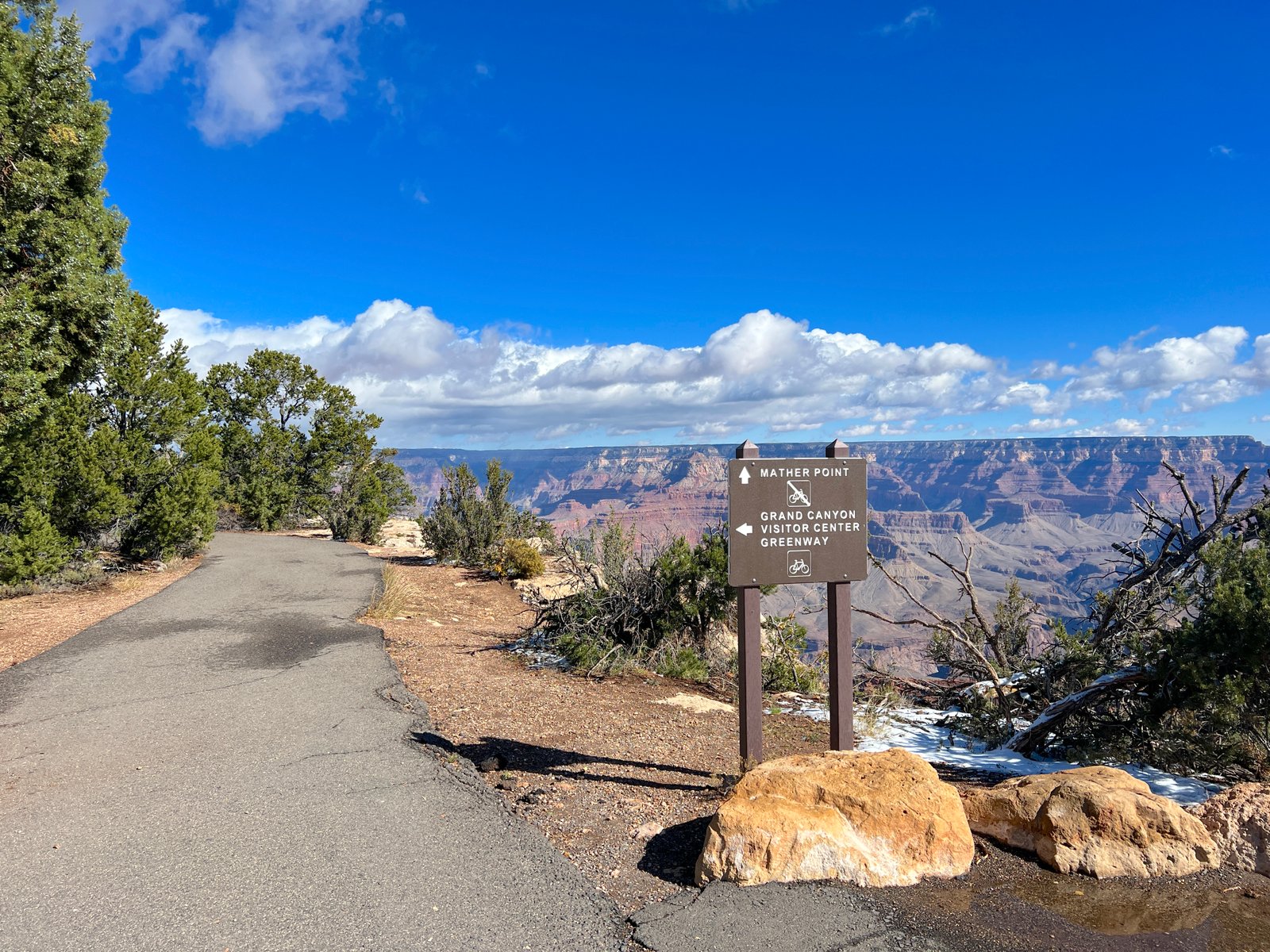
Different campgrounds put you close to different parts of the canyon. Here’s a quick guide to the best viewpoints and trails near each RV camping area so readers can plan their days without extra driving.
Trailer Village RV Park (South Rim)
You’re right in the heart of the South Rim, with easy access to the most iconic viewpoints.
- Mather Point – closest major viewpoint; perfect for sunrise
- Yavapai Point – excellent geology displays and wide canyon views
- Rim Trail – paved, easy, and accessible from the Visitor Center area
- Pipe Creek Vista – quieter sunrise spot
Why it’s great: You can walk or take the shuttle to most viewpoints without moving your RV.
Mather Campground (South Rim)
A short walk or shuttle ride puts you at the main viewpoints.
- Mather Point – closest viewpoint
- Yavapai Point – great for sunset
- South Kaibab Trailhead – shuttle access only
- Rim Trail – easy access from the Visitor Center
Why it’s great: Forested camping with quick access to the busiest, most photogenic part of the canyon.
Desert View Campground (South Rim)
You’re on the quiet east side of the South Rim with fewer crowds and big views.
- Desert View Watchtower – one of the best panoramas in the entire park
- Navajo Point – stunning sunrise spot
- Lipan Point – incredible for photography
- Moran Point – wide, layered canyon views
Why it’s great: The east rim viewpoints are quieter and perfect for sunrise/sunset photography.
North Rim Campground
You’re steps from quieter, more intimate viewpoints.
- Bright Angel Point – the signature North Rim viewpoint
- Transept Trail – beautiful forested trail with canyon overlooks
- Roosevelt Point – quiet, scenic stop
- Cape Royal & Angel’s Window – some of the best views in the entire park
Why it’s great: You’re steps from quiet, uncrowded viewpoints like Bright Angel Point, with easy access to peaceful forest overlooks.
If you want a deeper look at the most scenic overlooks, our Best Grand Canyon Viewpoints guide highlights the top spots on both the South Rim and North Rim, with tips for timing, photography, and avoiding crowds.
Which Grand Canyon Campground Is Right for You?
Choosing the right RV campground at the Grand Canyon depends on your rig size, the type of experience you want, and how much convenience you need. Use this guide to match your travel style with the best option.
If you want full hookups inside the park
Choose: Trailer Village RV Park (South Rim)
You want the easiest, most comfortable RV experience with water, electric, and sewer right at your site. Trailer Village is the only place inside the park that offers full hookups, making it ideal for longer stays, winter visits, and families who want amenities close by.
If you prefer quiet, forested camping inside the park
Choose: Mather Campground (South Rim)
You don’t need hookups and you prefer a peaceful, wooded setting. Mather offers privacy, shade, and easy shuttle access. It’s perfect for budget travelers, photographers, and anyone who wants a more natural camping experience.
If you want the most scenic, peaceful South Rim experience
Choose: Desert View Campground (South Rim – East)
You have a smaller RV and love sunrise and sunset views. Desert View is quiet, remote, and steps from the Watchtower. It’s dry camping only, but the scenery makes up for it.
If you want cooler temperatures and fewer crowds
Choose: North Rim Campground
You prefer solitude, forested landscapes, and cooler weather. The North Rim is only open seasonally, but it’s dramatically quieter and more peaceful than the South Rim. Ideal for photographers and hikers.
If you want free boondocking near the canyon
Choose: Kaibab National Forest (North Rim) or Coconino National Forest (South Rim)
You’re comfortable with dispersed camping and want space, privacy, and zero campground fees. Forest roads near both rims offer excellent boondocking options. Best for self‑sufficient RV travelers and long-term stays.
If you want a quiet, forested campground close to the North Rim
Choose: DeMotte Campground (North Rim)
You want a peaceful national‑forest setting just minutes from the North Rim entrance. DeMotte is great for smaller rigs and travelers who prefer rustic camping without crowds.
If you want a cooler, high‑country basecamp with easy access to supplies
Choose: Jacob Lake Campground (North Rim)
You don’t mind being farther from the rim and want a quiet forest stay near the Jacob Lake Inn. It’s a great backup when DeMotte or the in‑park campground are full.
If you want full hookups near the North Rim
Choose: Kaibab Camper Village (Jacob Lake)
You prefer the comfort of full hookups and level pads. This is the only full‑hookup option near the North Rim and ideal for big rigs or travelers wanting convenience.
If you want to be close to the South Rim but everything inside the park is full
Choose: Grand Canyon Camper Village (Tusayan)
You want convenience and proximity. Tusayan is minutes from the entrance and offers partial and full hookups, plus shuttle access into the park. Great for last-minute planners.
If you want full amenities, lower prices, and a Route 66 experience
Choose: Railside RV Ranch or Circle Pines KOA (Williams)
You don’t mind being an hour from the canyon and want full hookups, laundry, showers, and family-friendly amenities. Williams is perfect for longer stays and travelers who want to explore Route 66.
If you want wide‑open desert views and fewer neighbors
Choose: Grand Canyon Junction RV (Valle)
You prefer space, quiet, and affordability. Valle is a great midpoint between Williams and the South Rim, with big‑rig‑friendly sites and a peaceful desert setting.
If you want cooler temperatures and full services in summer
Choose: Flagstaff RV Parks
You want full hookups, shade, and access to major stores. Flagstaff is ideal for summer RV travel and longer stays, especially if you’re exploring multiple northern Arizona destinations.
Why Planning Matters
The Grand Canyon is one of the most visited national parks in the U.S., and RV camping is extremely popular. A little planning ensures you get the type of site you want — whether that’s full hookups in Trailer Village, a quiet forested loop at Mather, or a wide‑open boondocking spot under the pines.
Dump Stations, Water Fills & Fuel
Finding services around the Grand Canyon can take planning, especially if you’re staying in dry campgrounds or boondocking. The South Rim has the most reliable options — Trailer Village offers a year‑round dump station and potable water, and Mather Campground provides additional water fill points. Tusayan has fuel, propane, and basic RV supplies just outside the park entrance.
On the North Rim, services are more limited. The North Rim Campground has a seasonal dump station and potable water available only when the park is open. Jacob Lake offers fuel and a small store, but there are no dump stations outside the park until you reach Fredonia or Kanab. If you’re boondocking in Kaibab National Forest, plan to arrive with full tanks and leave with enough to reach the next town.
Fuel availability is generally good along Highway 64, Highway 180, and in Williams, Flagstaff, and Valle. Prices are higher near the park, so topping off before you arrive is usually the best strategy.
Frequently Asked Questions (FAQ)
Can you sleep in your RV inside Grand Canyon National Park?
Yes — Trailer Village (full hookups), Mather Campground (dry camping), and Desert View Campground (dry camping) all allow RV camping. Overnight parking outside designated campgrounds is not allowed.
Do RV sites have hookups?
Trailer Village is the only in‑park option with full hookups. Everything else on the South Rim and North Rim is dry camping.
Is generator use allowed?
Yes, but only in designated loops and during posted hours (usually morning and early evening). National forest boondocking areas also allow generators, but be mindful of noise.
Can big rigs fit at the Grand Canyon?
Trailer Village, Tusayan RV parks, Williams RV parks, and Valle RV parks all accommodate large RVs. Mather, Desert View, and the North Rim Campground are best for rigs under 30 feet.
Is there cell service?
South Rim: generally good around the Village area (Verizon strongest). North Rim: spotty to weak. Boondocking areas: varies widely.
Can you boondock inside the park?
No — dispersed camping is not allowed inside the national park. Boondocking is available in the Kaibab National Forest just outside both rims.
Are dogs allowed?
Yes, in campgrounds and on paved areas. Dogs are not allowed on most trails below the rim. Always keep pets leashed.
Can you get propane inside the park?
Yes — Trailer Village offers propane refills. Tusayan also has propane available.
Do you need reservations?
For summer and fall: absolutely. Trailer Village, Mather, Desert View, and the North Rim Campground all book out months ahead. National forest campgrounds and boondocking areas do not require reservations.
Is the North Rim open year‑round?
No — it’s open mid‑May through mid‑October. The road closes in winter due to snow.
Can you take an RV on Desert View Drive?
Yes — the road is RV‑friendly, but parking at viewpoints can be tight during peak hours.
Related Guides for Planning Your Grand Canyon Trip
• Grand Canyon Packing List (What to Bring for Your Trip + Hikes)
• Best Easy Hikes in the Grand Canyon (Top Trails for Beginners)
• Best Things to Do at the Grand Canyon South Rim
• Best Grand Canyon Viewpoints (South Rim + North Rim)
• One Day at the Grand Canyon South Rim: Complete Itinerary
• One Day at the Grand Canyon North Rim: Complete Itinerary
Helpful Links
Grand Canyon National Park Official Website – Park hours, entrance fees, campground details, and current conditions. https://www.nps.gov/grca
South Rim Campgrounds – Mather Campground reservations (Recreation.gov): https://www.recreation.gov/camping/campgrounds/232487
Trailer Village RV Park (Delaware North): https://www.visitgrandcanyon.com/lodging/trailer-village-rv-park
Desert View Campground info: https://www.nps.gov/grca/planyourvisit/cg-dv.htm
North Rim Campgrounds – North Rim Campground (Recreation.gov): https://www.recreation.gov/camping/campgrounds/232489
DeMotte & Jacob Lake Campgrounds (Kaibab National Forest): https://www.fs.usda.gov/kaibab
Kaibab Camper Village: https://www.kaibabcampervillage.com
Tusayan, Williams & Valle RV Parks
Grand Canyon Camper Village (Tusayan): https://www.grandcanyoncampervillage.com
Circle Pines KOA (Williams): https://koa.com/campgrounds/williams-circle-pines
Railside RV Ranch (Williams): https://railsidervranch.com
Grand Canyon Junction RV (Valle): https://grandcanyonjunctionrv.com
Raptor Ranch RV Park (Valle): https://www.raptor-ranch.com
Road Conditions & Weather
Arizona DOT Road Updates: https://www.az511.gov
Grand Canyon Weather Forecasts: https://www.weather.gov/fgz
Maps & Trip Planning
Grand Canyon Park Maps: https://www.nps.gov/grca/planyourvisit/maps.htm
Kaibab & Coconino National Forest Maps: https://www.fs.usda.gov/main/kaibab/maps-pubs | https://www.fs.usda.gov/main/coconino/maps-pubs